

Ipamorelin
← Back to LibraryCompound Profile
Ipamorelin is reviewed here for growth-hormone signaling and recovery context.
Research Summary

Safety notices, literature searches, limited protocol data

Growth-hormone signaling, Recovery, Body composition

Target context: GHS-R1a

Limited, unclear, or affected by safety flags.

Claims need extra caution because evidence is thin or safety flags apply.
 Route(s)
Subcutaneous
Route(s)
Subcutaneous
 Typical dose
100mcg - 200mcg
Typical dose
100mcg - 200mcg
 Dosing window
Pre-Bed Fasted
Dosing window
Pre-Bed Fasted
 Receptor / target
GHS-R1a
Receptor / target
GHS-R1a
 Properties
GH Secretagogue
Pre-mixed
No
Properties
GH Secretagogue
Pre-mixed
No
How ipamorelin works in the body
Ipamorelin is discussed through ghrelin-related growth-hormone signaling, with downstream liver IGF-1 and muscle context. Tap a glowing point to see the pathway.
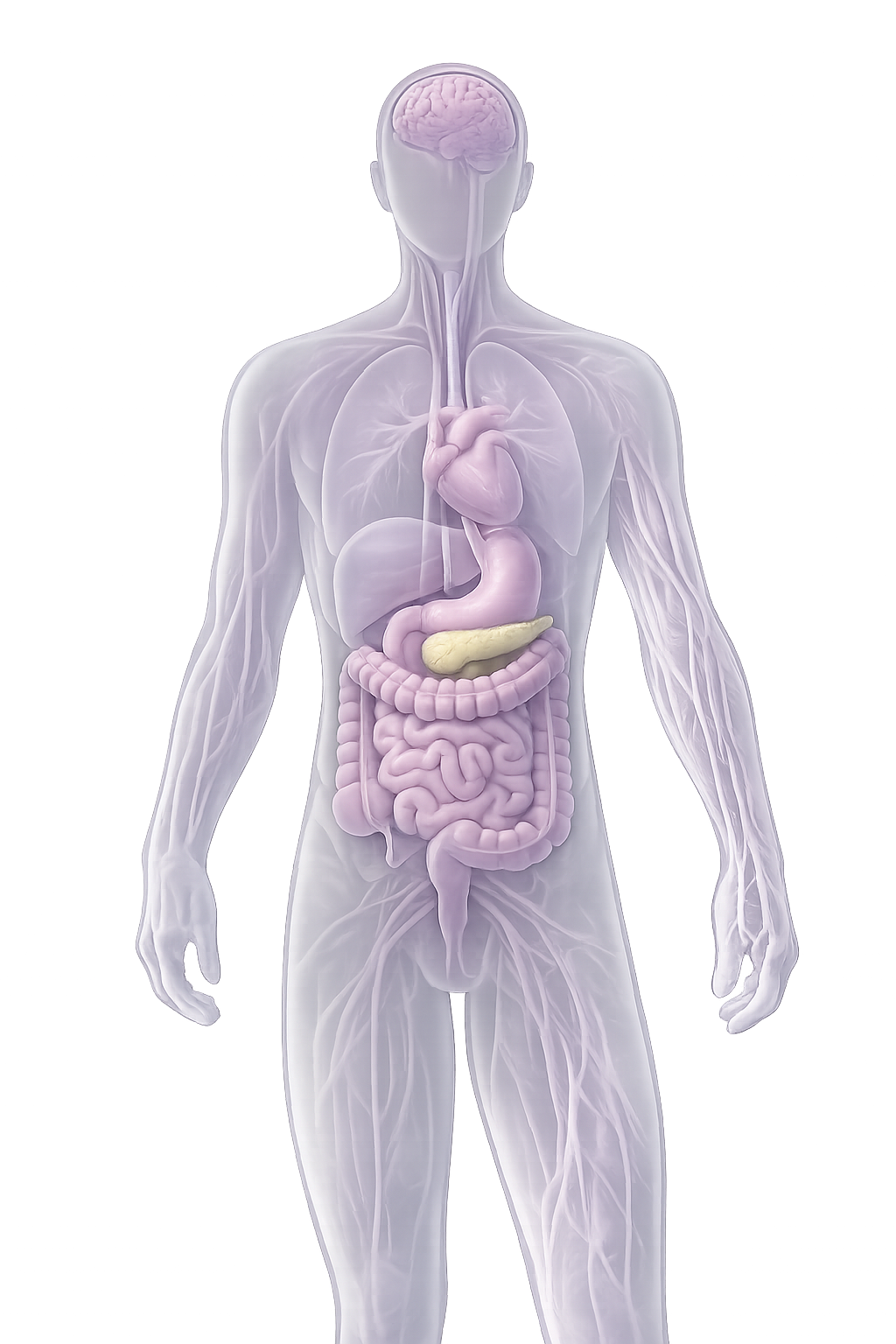
This is here to help you learn and is not medical advice. Evidence labels show how much human research stands behind each effect.
Protocols
Standard Protocol
| Timeframe | Dose | Notes |
|---|---|---|
| Weeks 1-12 | 100mcg - 200mcg once daily | Administered pre-bed, usually stacked with CJC-1295. |
Protocol example for research-context comparison; verify against the evidence status and listed medical sources.
Alternative: Saturation Protocol
| Timeframe | Dose | Notes |
|---|---|---|
| Weeks 1-12 | 300mcg 2x to 3x daily | Ipamorelin has a saturation dose of roughly 300mcg/injection. Dosing higher yields diminishing returns. |
Alternative research-context example; not an approved-label regimen unless marked above.
Alternative Titration 2: Gradual Approach
| Timeframe | Dose | Notes |
|---|---|---|
| Weeks 1-2 | 100 mcg 1x Daily at bedtime fasted | |
| Weeks 3-4 | 150 mcg 1x Daily at bedtime fasted | |
| Weeks 5-8 | 200 mcg 1x Daily at bedtime fasted | |
| Weeks 9-12 | 250 mcg 1x Daily at bedtime fasted |
Alternative research-context example; not an approved-label regimen unless marked above.
Protocol logic check
Medical literature and study context
Medical-source summary: This section ties the page to medical literature, drug labels, trial registries, and regulatory sources. It is educational context only and should not be read as medical advice or a use recommendation.
| Evidence position | FDA safety-risk context or unapproved compounded-use warning is attached to this entry; no FDA-approved human label was identified for this compound/page context. |
|---|---|
| Where studied | Studied around pituitary GH signaling, IGF-1 response, body-composition endpoints, growth-hormone deficiency models, or discontinued anabolic programs depending on the compound. |
| Source systems checked | FDA regulatory pages; PubMed/PMC literature; ClinicalTrials.gov records |
| Target and route context | Target/receptor: GHS-R1a. Route(s): Subcutaneous. Dosing window on page: Pre-Bed Fasted. |
| Protocol anchor | No source-backed label or clinical-trial regimen was identified for this page; protocol examples are research-context comparisons only. |
| Main evidence limit | Key limitation: FDA safety-risk context plus missing approved-label dosing; published mechanisms do not remove compounding, purity, sterility, or human-safety uncertainty. |
Source-linked findings
- GH-axis compounds are best interpreted through pituitary physiology, IGF-1 response, pulse timing, and metabolic adverse effects rather than dose escalation alone.
- Evidence strength ranges from approved labels for specific agents to sparse or discontinued development programs for research peptides.
- FDA lists ipamorelin acetate in category 2/withdrawn lists with immunogenicity/impurity concerns and serious adverse events reported in IV literature.
Protocol and study notes
- No source-backed label or clinical-trial regimen was identified for this page; protocol examples are research-context comparisons only.
- On-page protocol examples summarized for comparison: Standard Protocol: Weeks 1-12, 100mcg - 200mcg once daily; Alternative: Saturation Protocol: Weeks 1-12, 300mcg 2x to 3x daily.
- Key limitation: FDA safety-risk context plus missing approved-label dosing; published mechanisms do not remove compounding, purity, sterility, or human-safety uncertainty.
- Monitor IGF-1 response, fasting glucose/A1c, edema, carpal-tunnel symptoms, blood pressure, sleep apnea, and malignancy history.
Selected medical sources
Independent evidence
Regulatory status: unapproved or compounded peptide with FDA safety risk flag
Storage
No approved-label storage guidance was identified for this entry. Use conservative sterile handling and see the general storage guidance in the FAQ.
Contraindications & cautions
Evidence varies by item. Some points come from labels, published literature, or regulatory context; others are mechanism-based cautions that still need confirmation against medical literature. Use the medical sources below to verify details.
- Active cancer or history of malignancy: GH/IGF-1 elevation may promote tumor cell proliferation.
- History of hormone-sensitive malignancies (breast, prostate, colorectal): IGF-1 is a growth factor for these tumor types.
- Active acromegaly or pituitary disorders involving GH excess.
- Diabetic ketoacidosis.
- Diabetes mellitus or significant insulin resistance: GH elevation reduces insulin sensitivity; monitor fasting glucose.
- Concurrent use with GHRP-2 or GHRP-6: receptor competition at GHS-R1a; do not combine two GHRPs.
- Concurrent use with HGH 191aa: additive GH elevation creates redundant axis overstimulation.
- Concomitant glucocorticoid therapy: suppresses pituitary GH response.
- Pregnancy: safety not established.
- Breastfeeding: safety not established.
- Known hypersensitivity to ipamorelin or any formulation excipients.
- Pediatric use in children with closed growth plates.
- Severe cardiac disease or heart failure: GH elevation can increase cardiac workload.
Possible side effects
Evidence varies by item. Some points come from labels, published literature, or regulatory context; others are mechanism-based cautions that still need confirmation against medical literature. Use the medical sources below to verify details.
- Headache: most commonly reported adverse effect; caused by acute GH pulse-induced vasodilation; typically occurs in the first 1-2 weeks and diminishes with continued use; reported in approximately 20-35% of users in early weeks.
- Mild fatigue or lethargy: transient; within 30-60 minutes post-injection; associated with the GH pulse.
- Dizziness or lightheadedness: approximately 10-15% anecdotally; transient vasodilation; resolves within 30 minutes.
- Injection site irritation: redness, swelling, minor discomfort; reported in approximately 20-30% with subcutaneous injection.
- Mild water retention: GH-mediated sodium and fluid retention; approximately 15% anecdotally; less than CJC-1295 alone; more common in first 2-4 weeks.
- Mild nausea: rare; less than 5% at standard doses; more common at 300mcg+.
- Slight increase in appetite: modest orexigenic effect from GHS-R1a activation; minimal compared to GHRP-6.
- Joint stiffness: GH-mediated periarticular fluid; typically at higher-dose multi-injection protocols.
- Tingling or numbness in hands or feet: paresthesia; less common than with CJC-1295 DAC.
- Vivid dreams: GH elevation during nocturnal sleep cycle.
- Transient mild hypoglycemia: possible when combining with CJC-1295 in a fasted state; GH pulse transiently shifts glucose partitioning.
- Long-term insulin resistance (theoretical, dose and duration dependent): sustained IGF-1 elevation may reduce insulin sensitivity over extended cycles; no direct evidence from ipamorelin-specific studies.
Compatibility
The relationships below are heuristic compatibility notes and were not independently verified. Treat them as a starting point for a conversation with a clinician. They carry no safety guarantee.
Reported synergistic:
Reported contraindicated combinations: